

Advisor Departures at Edward Jones: A Five‑Year Analysis
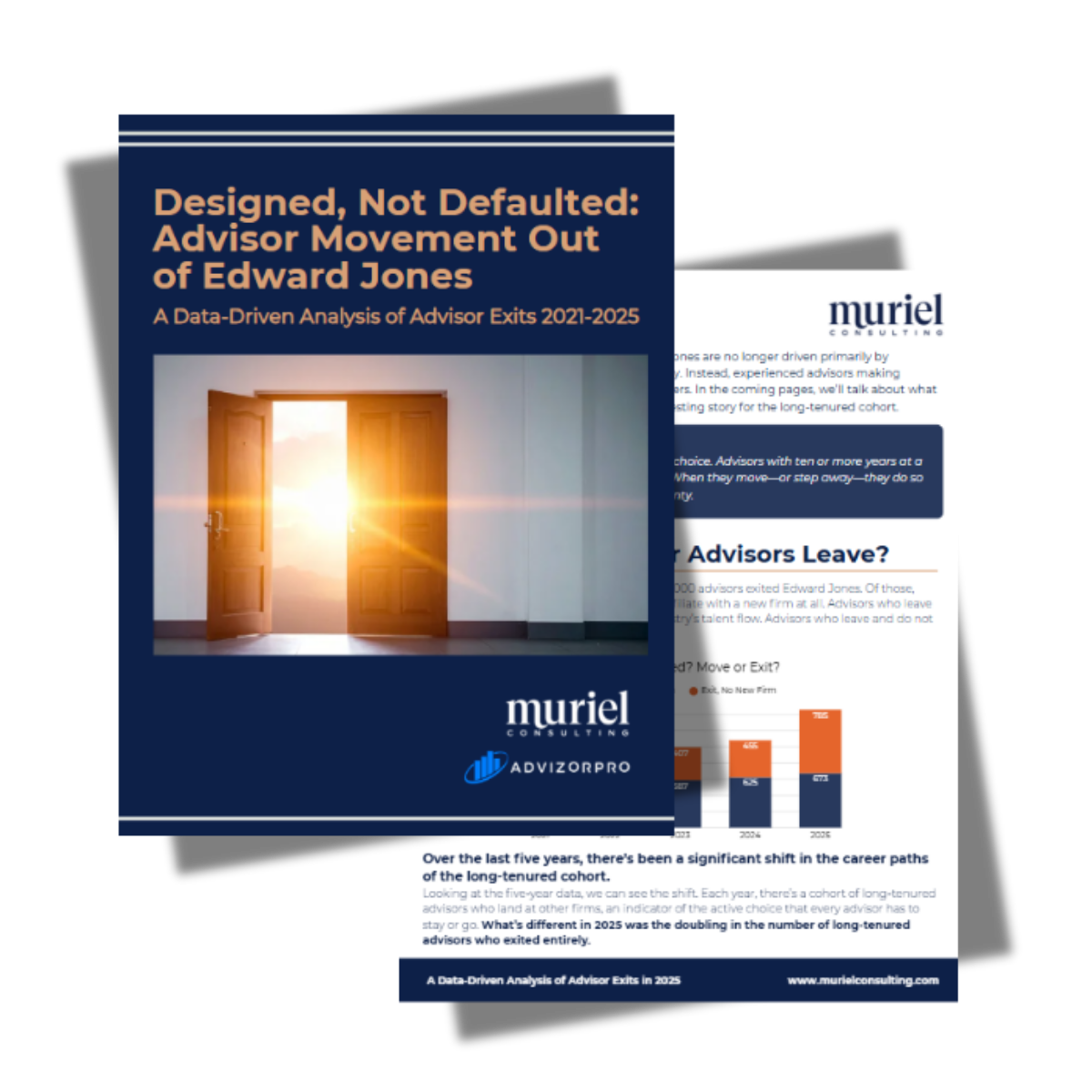
Edward Jones has long been recognized for stability, cultural cohesion, and advisor tenure. Over the past five years, patterns in advisor departures have shifted.
This analysis examines advisor departures from Edward Jones over the past five years. Rather than assessing total departures alone, the research evaluates who left—and how that composition changed over time.
Common Questions About This Research
-
Advisors rarely make career decisions in isolation. When evaluating their futures, they look for context—how peers have navigated similar moments, what options others have chosen, and how those decisions unfolded over time.
One of the most common early questions we hear from advisors considering change is:
“Where have others like me gone?”
This research helps answer that question by examining advisor departures through the lens of tenure and career stage. While no dataset can explain individual motivations, understanding peer movement provides valuable perspective as advisors assess their own paths.
The intent is not to direct outcomes, but to support more intentional, informed decision‑making.
-
This analysis is relevant to several audiences across the wealth management ecosystem:
Advisors evaluating their options
For advisors considering independence, firm changes, or succession timing, this research offers one data point—among many—to help contextualize personal experience within broader industry patterns.Firms seeking to attract Edward Jones alumni
For firms recruiting experienced advisors, understanding when and how long‑tenured advisors tend to move can inform recruiting strategy, advisor support models, and integration planning.Industry leaders and strategists
At a broader level, advisor movement reflects structural forces such as demographics, succession economics and evolving firm models. This work can inform the client-focused strategies and attraction efforts. -
This research does not seek to attribute intent, motivation, or causation to individual advisors or firms.
What the data does do is surface patterns that naturally raise questions. Those questions are informed further by a broader set of inputs, including public commentary from Edward Jones leadership, coverage and analysis from industry news media, and ongoing conversations with advisors and other informed industry participants.
Taken together, these perspectives help fill in gaps that no single dataset can address on its own.
The goal of this research is not finger‑pointing or assigning blame. It is to encourage thoughtful, data‑grounded conversation—one that allows advisors, firms, and industry leaders to better understand the forces shaping career decisions and strategic options in a changing landscape.
-
The analysis is based on third‑party advisor data sourced from AdvizorPro, an industry‑standard database tracking advisor employment history, registrations, and firm affiliations.
In summary:
The analysis examines advisors whose most recent prior firm was Edward Jones
The time frame spans a five‑year period
Non‑advisor individuals were excluded
Tenure at the time of departure was a key analytical lens
Further methodology details are available in the full research paper.
-
Yes. As with all third‑party datasets, this research has limitations.
The data reflects completed registration changes, not when advisors began evaluating options
Assets under management (AUM) associated with departures are not available
Individual motivations and internal firm dynamics cannot be inferred from the data alone
These limitations are important to acknowledge and reinforce the need to interpret the findings thoughtfully.
-
Open, data‑based discussion benefits the industry as a whole.
By sharing this analysis publicly—and transparently—our goal is to contribute to a more informed conversation around advisor mobility, succession, and strategic choice, while allowing readers to review the data, methodology, and interpretation for themselves.
We believe strongly in publishing accurate, data‑based research to help advisors and firms evaluate opportunities and pursue their long‑term ambitions.
In connection with the publication of this research on advisor departures from Edward Jones, Muriel Consulting founder Shelby Nicholl received a cease and desist letter from legal counsel representing Edward Jones. The research itself was developed and scheduled for release prior to receipt of that correspondence and has been published as planned.
The following timeline provides factual context around the publication of this research and the subsequent public discussion. It is included to help readers understand the sequence of events related to the analysis and is provided solely for clarity.
Research Context and Timeline
February 27, 2026
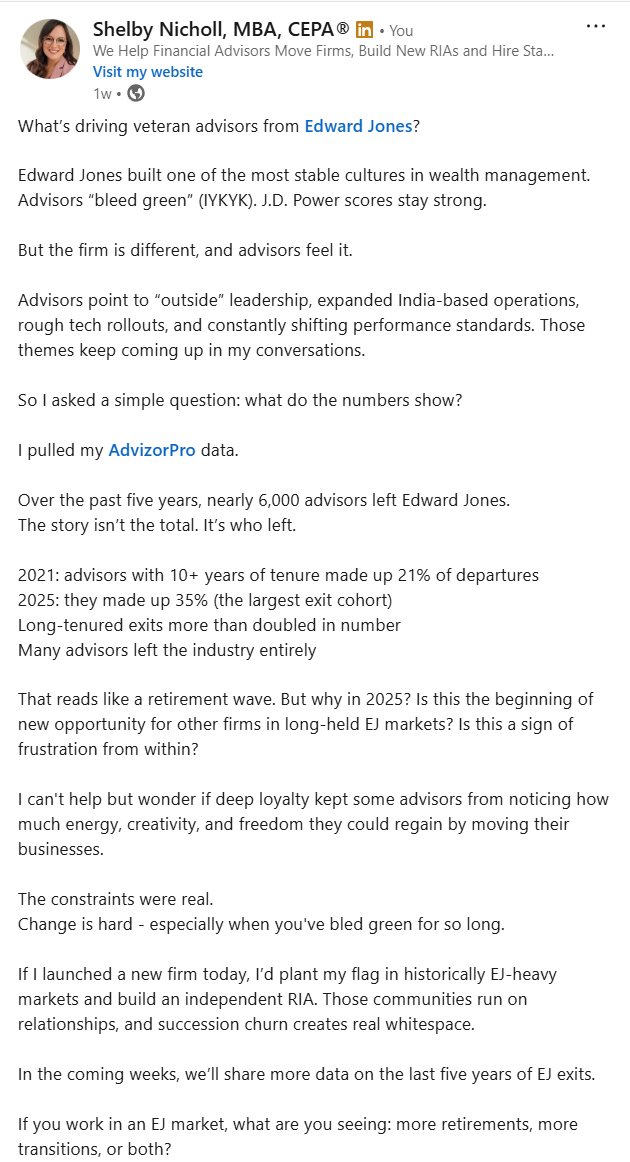
Initial research insights and observations related to advisor departures from Edward Jones were shared publicly on LinkedIn, based on third‑party data analysis.
March 4, 2026
Shelby Nicholl was interviewed by AdvisorHub about the research report for a story to be published on March 9, 2026.
March 4, 2026
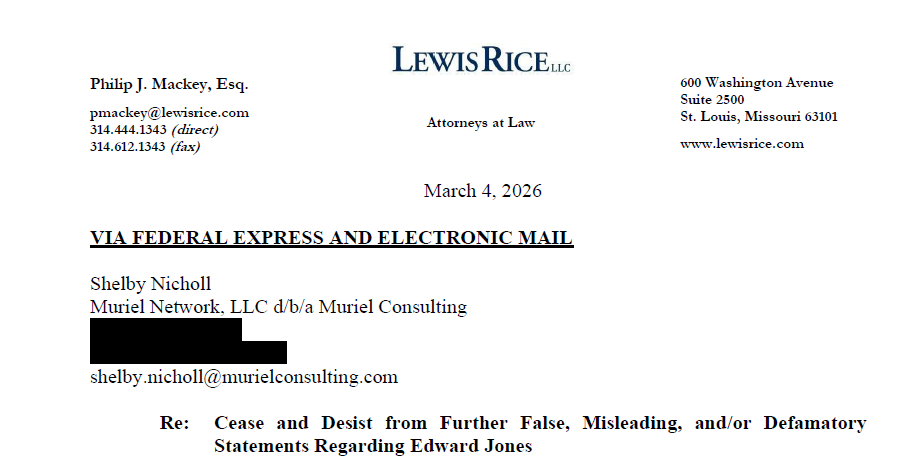
A cease and desist letter was received from legal counsel representing Edward Jones regarding public commentary published on Feb. 27, 2026 on the research findings. This letter arrived after Shelby Nicholl was interviewed by AdvisorHub.
March 9, 2026 to March 25, 2026
Media coverage related to the research was published.
Check out these articles:
March 12, 2026
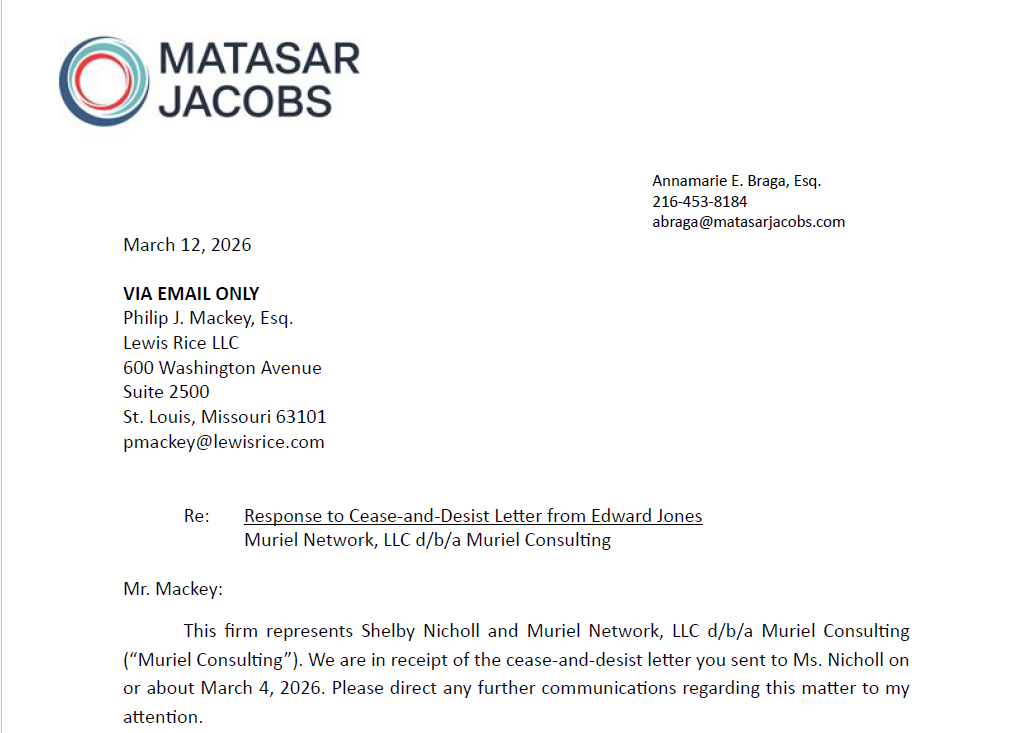
Our counsel, Matasar Jacobs, sent a formal response to Edward Jones’ counsel. See below.
March 16, 2026
Edward Jones counsel responds to our response.

Additional Insights by Muriel Consulting
Insight Paper: When Stability Meets Consolidation - Lessons from Commonwealth Advisors
This insight paper examines advisor behavior following LPL Financial’s acquisition of Commonwealth Financial Network.
At the time of the acquisition, LPL publicly stated a goal of retaining approximately 90% of Commonwealth advisors. This paper evaluates what happened next—where advisors chose to stay, where they chose to move, and what those decisions reveal about advisor priorities during periods of significant structural change.
The paper offers practical insight into what consolidation looks like from the advisor’s perspective—and what outcomes firms should realistically expect when change is introduced into historically stable environments.

The Fit Test: A Self-Reflection Guide
Career transitions are rarely about a single factor. Compensation, culture, control, growth opportunity, and personal goals all play a role—and misalignment often builds quietly over time.
The Fit Test is a guided self‑reflection tool designed to help advisors:
assess whether their current firm still fits how they want to work
clarify what matters most before engaging in conversations
move from vague dissatisfaction to intentional evaluation
The goal is not to prompt change, but to support clarity.
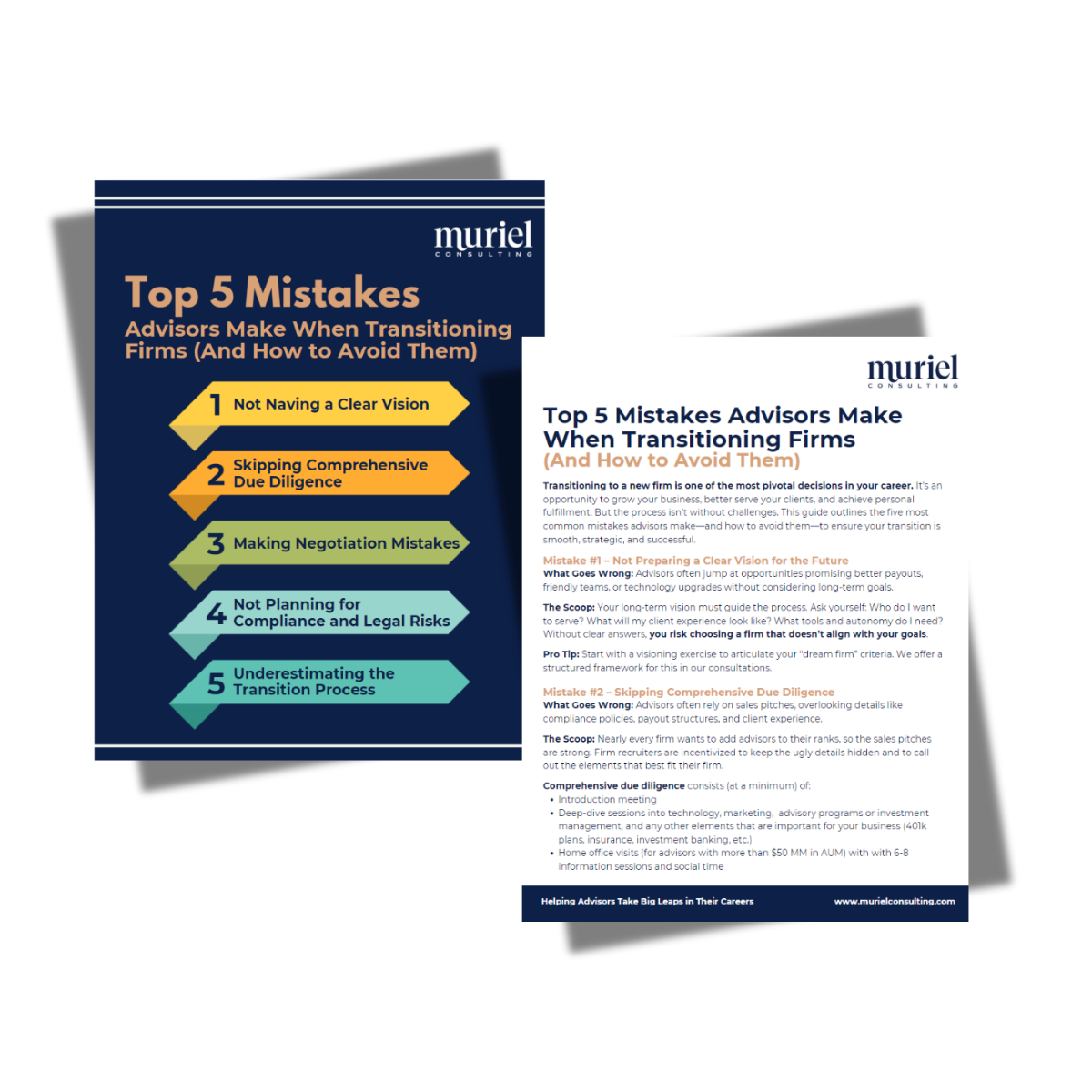
Top 5 Mistakes Advisors make When Moving Firms
Transitions carry real risk—financial, operational, and emotional. This paper outlines five common mistakes advisors make when changing firms, based on patterns observed across advisor moves and firm launches.
The paper is designed to help advisors avoid preventable missteps and approach transitions with greater intention and durability.
What Sets Us Apart
Our clients choose Muriel Consulting because we offer more than just introductions—we provide strategic, hands-on guidance every step of the way. Here’s what makes us different:

Unbiased & Personalized
Advice
As an independent firm, we have no hidden agendas or corporate ties.

Industry Expertise & Relationships
With extensive experience and a vast network, we open doors to the best solutions.

Comprehensive
Support
From vision to execution, we make sure you’re ready for launch day. Our Launch Support services bridge any gaps.
Are you evaluating what your next chapter could look like?
Advisors and firms often begin with questions, not answers.
If you are evaluating a potential transition, considering independence, planning succession, or assessing strategic options, a confidential conversation can help clarify what matters most—before any decisions are made.
There is no obligation, and all conversations are private.
